What is AI exactly?
A visual, beginner-friendly guide to what artificial intelligence really is — and what it isn't.

Artificial intelligence is everywhere in the headlines — but what is it, really? If you've used a voice assistant, received a product recommendation, or asked ChatGPT a question, you've already interacted with AI. Yet the term is often used so broadly that it becomes confusing.
This guide explains what AI actually is, how it works at a high level, and what it can and cannot do — with visuals to make the concepts stick.
What does "artificial intelligence" mean?
At its core, artificial intelligence (AI) refers to computer systems that can perform tasks that typically require human intelligence. That includes recognising images, understanding language, making decisions, and learning from experience.
Importantly, AI is not a single technology. It's an umbrella term covering many different approaches — from simple rule-based systems to sophisticated machine learning models trained on vast amounts of data.
A useful definition
AI is software that can learn patterns from data and use those patterns to make predictions or decisions — without being explicitly programmed for every possible scenario.
AI is not the same as automation
People often conflate AI with automation, but they're different:
- Automation follows fixed rules. A thermostat turns on the heating when the temperature drops below 20°C. Every time, same rule.
- AI learns from examples. A spam filter improves by seeing millions of emails labelled "spam" or "not spam" — it discovers patterns humans never explicitly coded.
Traditional software does exactly what a programmer tells it. AI systems, by contrast, figure out how to solve a problem by studying data.
Two types of AI: narrow and general
Not all AI is created equal. Understanding the distinction between narrow and general AI is one of the most important concepts for newcomers.
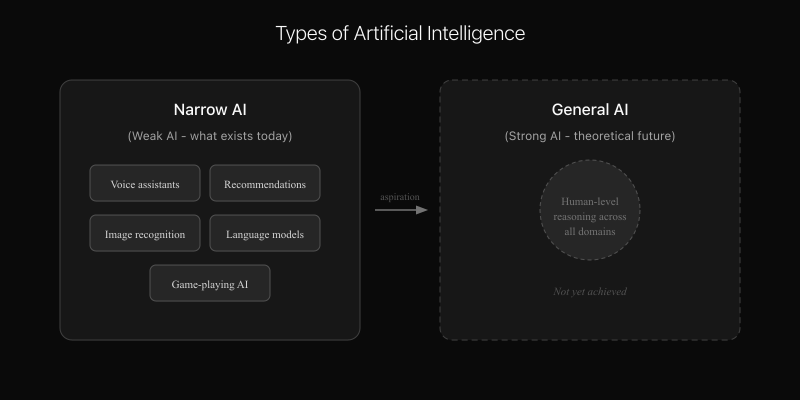
Narrow AI (also called weak AI) is designed for a specific task. Every AI system in use today falls into this category — including ChatGPT, Siri, self-driving car perception systems, and medical image analysis tools. They're impressive within their domain but can't generalise beyond it.
General AI (also called strong AI or AGI) would be a system with human-level reasoning across all domains — able to learn any intellectual task a person can. This does not exist yet. It's a research goal and a subject of active debate among scientists.
How does AI learn? The machine learning loop
Most modern AI is built on machine learning (ML) — a subset of AI where systems improve through experience rather than explicit programming.
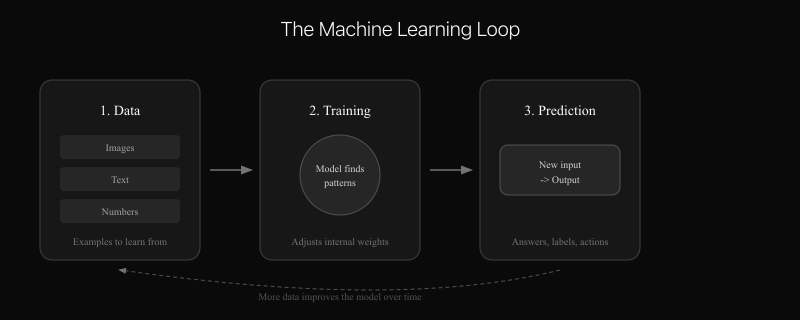
The process follows three core steps:
- Data — The system is fed examples: photos labelled "cat" or "dog", emails marked spam, customer purchase histories, medical scans with diagnoses.
- Training — The model analyses this data and adjusts its internal parameters (called "weights") to find patterns. This is computationally intensive and can take days or weeks on powerful hardware.
- Prediction — Once trained, the model can process new, unseen inputs and produce outputs: classify an image, translate text, predict the next word, flag a fraudulent transaction.
This feedback loop is why AI systems get better over time — more data generally means better performance.
AI in everyday life
You interact with AI more often than you might realise:
- Voice assistants (Siri, Alexa, Google Assistant) use speech recognition and natural language processing to understand and respond to you.
- Streaming recommendations (Netflix, Spotify, YouTube) analyse your behaviour and compare it to millions of other users to suggest content.
- Email spam filters learn from billions of emails to keep your inbox clean.
- Navigation apps predict traffic and suggest faster routes based on real-time and historical data.
- Face unlock on your phone uses facial recognition AI to verify your identity.
- Language tools like ChatGPT, Claude, and Gemini can write, summarise, translate, and reason about text.
Key AI terms you should know
- Algorithm — A set of instructions a computer follows. In ML, the algorithm defines how the model learns.
- Model — The trained AI system itself. After training, you have a "model" that can make predictions.
- Neural network — A type of ML model inspired by the brain, made of layers of interconnected nodes. Most modern AI uses neural networks.
- Deep learning — Neural networks with many layers ("deep" networks). Powers image recognition, language models, and more.
- Training data — The examples used to teach the model. Quality and quantity of data largely determine how good the AI is.
- Inference — Using a trained model to make predictions on new data. This is what happens when you ask ChatGPT a question.
What AI cannot do (common misconceptions)
Media hype can make AI seem magical. Here are important limitations:
- AI doesn't "understand" like humans. It finds statistical patterns in data. A language model can write eloquently about love without experiencing it.
- AI can be wrong confidently. Models sometimes produce plausible-sounding but incorrect answers — a phenomenon called "hallucination."
- AI reflects its training data. If the data contains biases, the AI will too. This is an active area of research and regulation.
- AI isn't conscious or sentient. Despite sci-fi portrayals, no current AI system has awareness, emotions, or intentions.
- AI can't replace human judgment everywhere. It's a powerful tool, but critical decisions in medicine, law, and safety still require human oversight.
Think of AI as a tool
Like a calculator for math or a search engine for information, AI is a tool that amplifies human capability. The best results come from humans and AI working together — not from expecting AI to replace human thinking entirely.
Where to learn more
If you'd like to go deeper, these resources are excellent starting points:
- Stanford Institute for Human-Centered AI (HAI) — Research and education on AI's societal impact.
- Google AI Essentials — Free course covering AI fundamentals for everyone.
- Elements of AI — Free online course from the University of Helsinki, no programming required.
- Anthropic Research — Papers and insights on AI safety and capabilities.
- OpenAI Research — Publications from one of the leading AI labs.
What's next?
Now that you understand what AI is at a high level, you might want to explore what a Large Language Model is — the technology behind ChatGPT, Claude, and similar tools that have captured the world's attention.
Or, if you're curious about the bigger picture, check out the current AI landscape for an overview of the major players, tools, and trends shaping the field in 2026.