The current AI landscape
An overview of the AI ecosystem as of July 2026 — major players, tools, and trends shaping the field.
Artificial intelligence is moving faster than at any point in its history. New models, tools, and applications appear every week. If you're trying to make sense of it all — whether you're a curious beginner or someone already using AI daily — this guide maps the terrain as it stands in July 2026.
The big picture
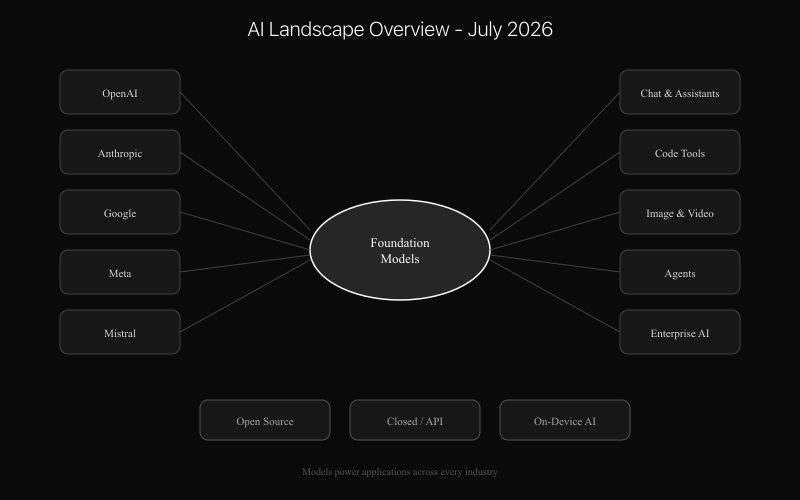
Today's AI ecosystem has three layers: foundation models built by research labs, applications that put those models in users' hands, and infrastructure that makes it all run. Understanding these layers helps you navigate the noise.
Major model providers
A handful of organisations build the foundation models that power most AI applications worldwide.
OpenAI
The company behind ChatGPT and the GPT model family. GPT-4 and GPT-4o remain among the most widely used models. OpenAI also offers image generation (DALL-E), voice, and an API used by thousands of developers. openai.com
Anthropic
Founded by former OpenAI researchers, Anthropic builds the Claude model family. Known for long context windows (up to 200K+ tokens), strong writing quality, and a focus on AI safety through "Constitutional AI." anthropic.com
Google DeepMind
Google's AI division, responsible for Gemini models integrated across Search, Workspace, Android, and Cloud. DeepMind also produced AlphaFold (protein folding) and continues research in robotics and science. deepmind.google
Meta AI
Meta's Llama family of open-source models has been one of the most impactful contributions to the AI community. Llama models can be downloaded, modified, and run on local hardware — democratising access to powerful AI. ai.meta.com
Mistral AI
A European AI company offering both open-source and commercial models. Known for efficient architectures that deliver strong performance with fewer resources. mistral.ai
Other notable players
- xAI — Elon Musk's AI company, building the Grok model family.
- Cohere — Enterprise-focused language models and retrieval tools.
- Stability AI — Open-source image, video, and audio generation.
- Midjourney — Leading AI image generation platform.
Application categories
Foundation models are the engine; applications are the cars. Here's how AI shows up in tools people use every day.
Chat and assistants
The most visible category. ChatGPT, Claude, Gemini, and Microsoft Copilot let anyone converse with AI for writing, research, coding, and problem-solving. These tools have become daily workflow staples for millions.
Code and development
AI coding assistants have transformed software development. GitHub Copilot, Cursor, and similar tools suggest code, explain errors, and even build entire features from natural language descriptions.
Image, video, and creative
AI can now generate photorealistic images, animate scenes, compose music, and edit video. Tools like Midjourney, DALL-E, Runway, and Suno have opened creative possibilities to people without traditional artistic training.
AI agents
The frontier in 2026. Agents go beyond chat — they can browse the web, use software, write and execute code, and complete multi-step tasks autonomously. Examples include OpenAI's Operator, coding agents, and custom enterprise agents built on frameworks like LangChain and CrewAI.
Open source vs closed models
One of the defining debates in AI is whether models should be open (weights publicly available) or closed (accessible only via API).
Open-source advantages: Run on your own hardware, customise for specific needs, no per-token API costs, full transparency into model behaviour.
Closed-model advantages: Typically more capable out of the box, maintained and updated by well-funded teams, safety measures built in, no infrastructure to manage.
Many organisations use a mix — closed models for general tasks, open models for specialised or privacy-sensitive workloads.
Multimodal AI: beyond text
The latest generation of models doesn't just process text — they understand and generate across multiple modalities:
- Vision — Analyse images, read documents, interpret charts and screenshots.
- Audio — Transcribe speech, generate realistic voices, understand tone and emotion.
- Video — Generate video clips from text descriptions, analyse video content.
- Code execution — Write and run code to solve problems, create visualisations, process data.
GPT-4o, Gemini, and Claude all offer multimodal capabilities, blurring the line between different types of AI tools.
Enterprise AI
Businesses are adopting AI at scale, with distinct needs from consumers:
- Custom fine-tuning — Training models on company-specific data for domain expertise.
- RAG (Retrieval-Augmented Generation) — Connecting LLMs to company knowledge bases for accurate, sourced answers.
- AI platforms — Microsoft Azure AI, Google Vertex AI, AWS Bedrock, and others offer managed AI infrastructure.
- Compliance and governance — Tools for monitoring AI outputs, ensuring data privacy, and meeting regulatory requirements.
Regulation and safety
As AI capabilities grow, so does regulatory attention:
- EU AI Act — The world's first comprehensive AI law, classifying AI systems by risk level and imposing requirements on high-risk applications. Phased implementation through 2026–2027.
- US approach — Executive orders and agency-level guidance, with ongoing congressional debate about federal AI legislation.
- AI safety research — Organisations like Anthropic, OpenAI's Superalignment team, and the UK AI Safety Institute focus on ensuring advanced AI systems remain controllable and beneficial.
- Industry standards — Frameworks for responsible AI development, bias testing, and transparency reporting.
A rapidly moving field
This landscape will look different in six months. New models, tools, and regulations emerge constantly. The best strategy is to understand the underlying concepts — which is exactly what our other guides cover.
Key trends to watch
- AI agents — Moving from chat to action. Models that can use tools, browse the web, and complete tasks independently.
- Smaller, efficient models — Running capable AI on phones, laptops, and edge devices without cloud connectivity.
- Reasoning models — Models that "think" step by step before answering, improving accuracy on complex problems.
- AI in science — Drug discovery, materials science, climate modelling — AI accelerating research across disciplines.
- Personalisation — AI that learns your preferences, writing style, and workflow over time.
- Open-source catching up — Open models increasingly competitive with closed alternatives, changing the economics of AI deployment.
Staying current
The AI field moves fast. Here are reliable ways to keep up:
- FutureTools — Curated directory of new AI tools, updated daily.
- Anthropic Research Blog — In-depth technical and policy writing.
- OpenAI Blog — Product announcements and research highlights.
- Google DeepMind Blog — Research breakthroughs and applications.
- Simon Willison's Blog — Practical, honest commentary on AI tools and development.
- One Useful Thing — Ethan Mollick on AI's impact on work and education.
Your learning path
If you haven't already, start with the fundamentals:
- What is AI exactly? — A beginner-friendly introduction to artificial intelligence.
- What is a LLM? — How Large Language Models work under the hood.
And explore the curated feeds on this page for the latest videos and tools in the AI space.